Helping a Child Who Feels Different From Other Children
It usually happens without warning. Your child comes home quieter than usual, and somewhere between the backpack and the snack, it comes out: "I wish my hair was straight like hers." "Everyone is faster than me." "Nobody sat with me today."
Comparison arrives earlier than most parents expect. Research on child development consistently finds that children begin comparing themselves to peers around ages four to six, right as they enter group settings. If your little one is noticing differences, nothing has gone wrong. They are right on schedule, and this is the season where the words you choose matter enormously.
First, resist the instinct to fix it fast
Our first reflex is usually to erase the feeling: "Don't be silly, your hair is beautiful!" It comes from love, but it can teach a child that the feeling itself was wrong. Try sitting in it with them for a moment instead:
"That sounds like it hurt. Tell me more about it."
Children who feel heard are far more open to what you say next.
Name the comparison out loud
Young children do not have language for what is happening to them. Giving it a name is a gift:
"You know what I think happened today? You looked at her, and then you looked at yourself, and you decided being different meant being wrong. That happens to grown ups too. But being different is not the same as being wrong."
Point to the specific, not the general
"You are special" is too big and too vague to land. Specific is what a child believes:
- "You are the one who notices when someone is left out. Not everyone can do that."
- "Your laugh makes the whole table laugh. That is a gift."
- "You never give up when something is hard, even when it takes you longer."
Aim for what only they carry. Children forget compliments about their appearance; they remember being seen.
Give them a truth bigger than the classroom
Peer opinion is loud, and it changes weekly. What holds up over time is identity that comes from somewhere sturdier. For our family, that anchor is Scripture:
"I praise You because I am fearfully and wonderfully made." Psalm 139:14
Said gently and often, that verse becomes the thing your child hears in their own voice when someone is unkind.
Watch what you say about yourself
Children learn self-talk by hearing yours. When you criticize your own body, your own work, your own worth out loud, they learn that this is what grown ups do. When you say "I like how God made me," they learn something else entirely.
Let a story carry the message
Sometimes a child will accept from a character what they resist from a parent. That is why I wrote Perfectly Made. Mia has wild curls and a laugh too big to hold in, and on the playground she wonders whether God made her wrong. Her mother does not just tell her she is beautiful. She opens the Bible and shows her.
If your child is in this season right now, read together, then ask the question that matters: "Have you ever felt like Mia?" You may be surprised how much comes out.
Keep the door open
One conversation will not settle this forever. Comparison will return at seven, at ten, at fourteen, in new clothing. What you are building now is not a one-time fix but a habit: when something hurts, we say it out loud in this house, and we take it to God together.
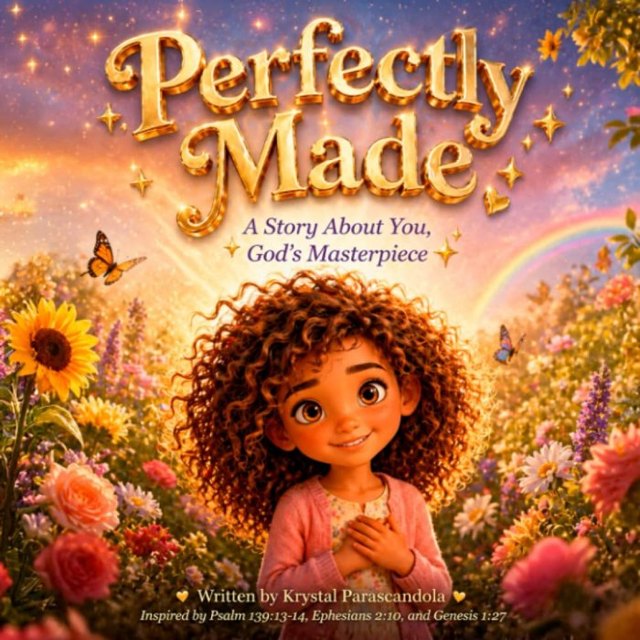
Perfectly Made
A Christian picture book for ages 3 to 7, rooted in Psalm 139:13-14, Ephesians 2:10, and Genesis 1:27. For every child who has ever wondered, "Am I enough?"
See the book →